


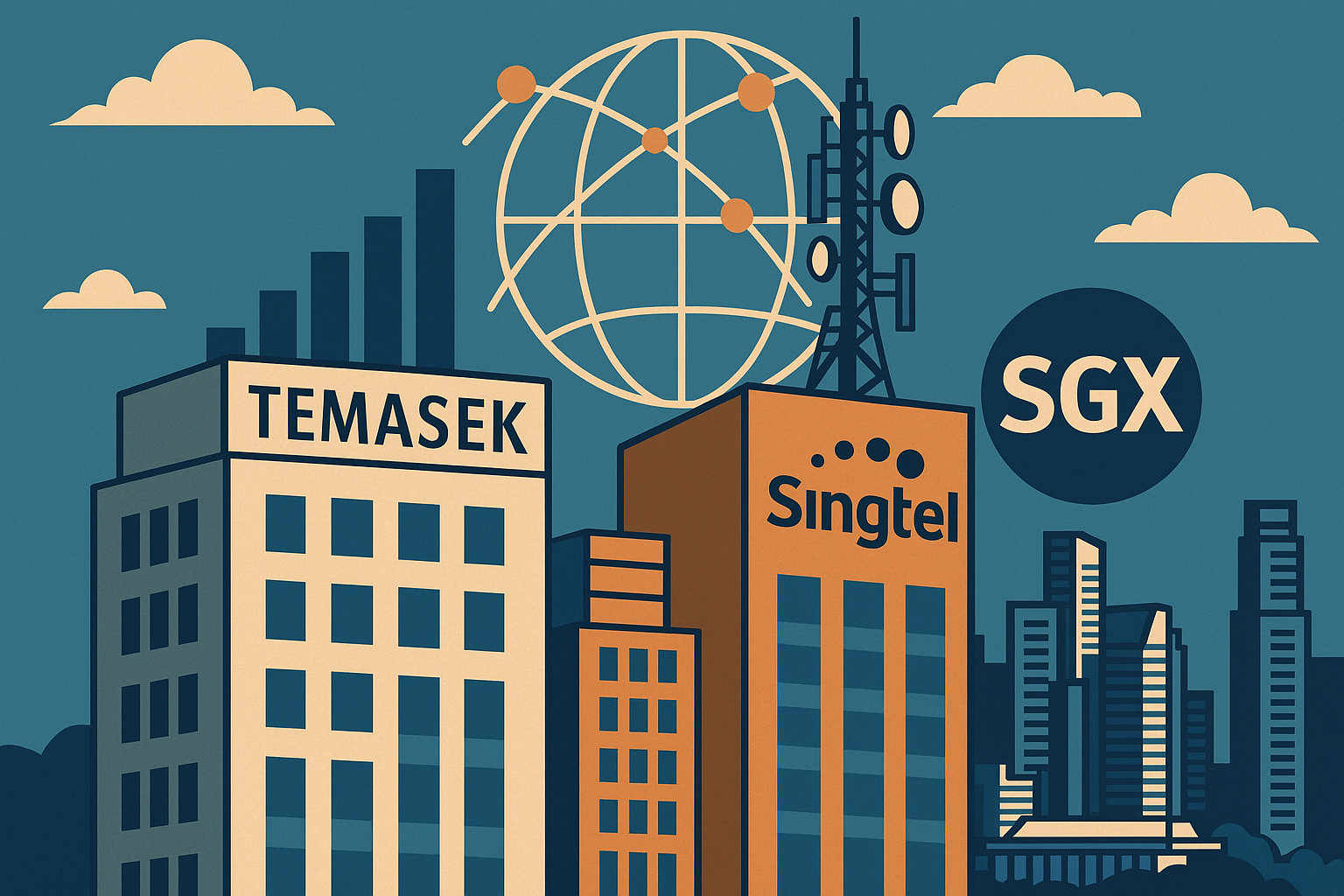
Temasek and Singtel represent two sides of Singapore’s economic strategy: state-backed, globally active capital on one hand, and a market-driven, regionally focused corporate champion on the other. Their interaction has shaped not only the telecommunications landscape, but also the composition and behavior of Singapore’s stock market over several decades.
Temasek’s core mandate is to deliver long-term risk-adjusted returns above its cost of capital, while also supporting the resilience of Singapore’s economy. Unlike a traditional government agency, Temasek operates under company law, with its own board of directors and investment team. It raises funds primarily through its portfolio returns and debt issuance rather than direct budgetary transfers. Its portfolio has steadily globalized, with significant allocations to Asia and increasing exposure to developed markets and private assets.
A distinctive feature of Temasek is its willingness to recycle capital. It is not a passive owner; it regularly divests from mature holdings, restructures underperforming companies, and backs new growth platforms. This approach is visible in its history with Singtel, where Temasek has supported the telco’s expansion beyond Singapore’s borders, backing acquisitions and investments that transformed Singtel into a regional player. Temasek’s involvement tends to stabilize strategic direction while giving management room to execute long-range plans.
Singtel itself is central to the SGX as one of the most heavily traded and widely held counters. Beyond its consumer mobile, broadband, and pay TV services in Singapore, Singtel has built a diversified portfolio of regional associate telcos. These stakes generate equity-accounted profits and expose Singtel to currency swings, regulatory changes, and competitive dynamics in multiple jurisdictions. As a result, Singtel’s share price often reflects broader regional telecom trends, not just domestic performance.
In recent years, Singtel has pushed aggressively into digital businesses. Its enterprise segment focuses on ICT services, cloud infrastructure, cybersecurity, and managed solutions for governments and large corporations. It also invests in digital infrastructure, including data centers and network modernization, to serve the rise of data-intensive applications. At the same time, Singtel has trimmed non-core assets and monetized infrastructure—such as tower or data center stakes—when valuations are attractive, using proceeds to strengthen the balance sheet or fund growth areas.
From a governance and risk perspective, the Temasek–Singtel nexus is important. Temasek’s large shareholding typically translates into board representation and close monitoring of capital allocation decisions. This can reduce the risk of overly aggressive expansion or imprudent leverage. However, Singtel remains accountable to a diverse shareholder base that demands transparency, competitive returns, and disciplined spending on 5G and digital ventures. Balancing income stability with investment for future growth is a recurring theme in analyst assessments of Singtel.
For investors studying the Singapore market, Temasek’s positioning and Singtel’s strategy function as leading indicators. Changes in Temasek’s portfolio mix can hint at shifting national and regional priorities, such as greater emphasis on sustainability, technology, or consumer sectors. Singtel’s performance, meanwhile, influences the Straits Times Index and provides a window into the health of telecom and digital infrastructure across Asia. Together, they form a useful lens for understanding how state capital and listed corporates interact in a small but globally connected financial hub.