
Singapore’s commercial space industry is developing beyond conventional satellite engineering as quantum communications, artificial intelligence and remote sensing open new opportunities for technology entrepreneurs in 2026.
The expansion reflects a broader change in the space economy. Satellites are increasingly becoming platforms for delivering digital services, from environmental intelligence to secure communications, rather than functioning exclusively as scientific or telecommunications infrastructure.
For startups, the opportunity lies in supplying specialised technology and developing services that connect orbital infrastructure with commercial requirements on Earth.
A New Agency Supports Singapore’s Space Ambitions
Singapore established the National Space Agency of Singapore on April 1, 2026, replacing the Office for Space Technology and Industry as the country’s principal organisation for national space development.
The agency coordinates national capabilities, research programmes, international cooperation and the development of space regulations.
According to official government figures, Singapore has approximately 70 companies working across the space industry and around 2,000 professionals and researchers.
This ecosystem includes businesses developing spacecraft components, satellite communications systems, geospatial platforms and specialised engineering solutions.
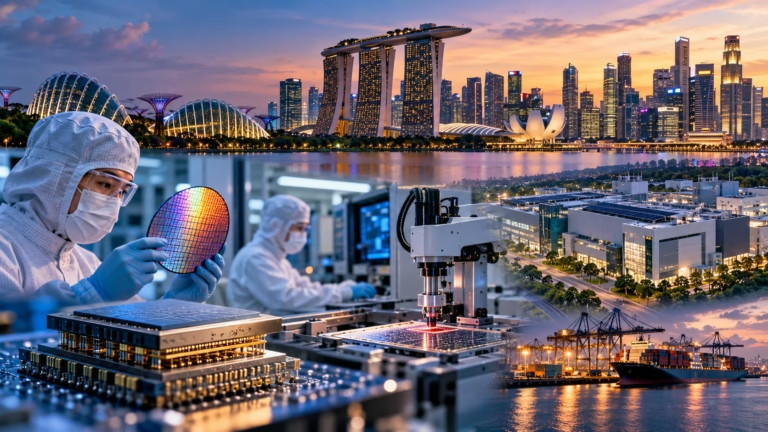
Singapore’s competitive position is supported by experience in advanced manufacturing, electronics, software development and financial technology.
Quantum Communications Highlight Emerging Space Services
A notable development occurred in August 2026 when Singapore-based SpeQtral took operational control of the SpeQtre satellite from its British mission partner, RAL Space.
The satellite, launched in November 2025, entered a new phase of quantum communications experimentation.
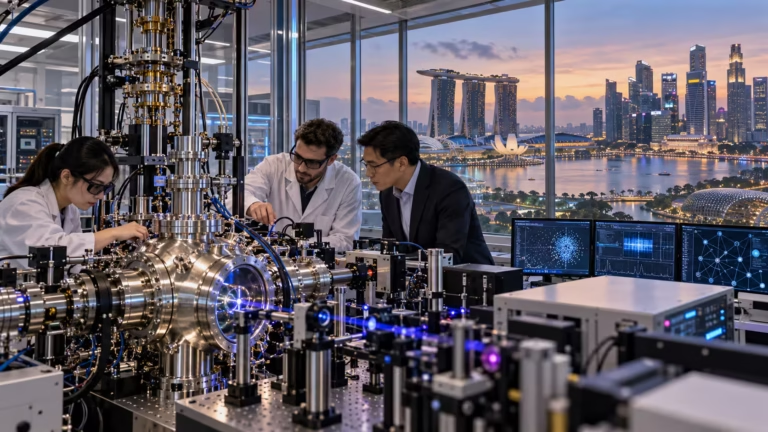
As described in SpeQtral’s August 5, 2026 announcement, researchers are working to calibrate optical links between the spacecraft and ground stations.
The project is intended to advance satellite-based quantum key distribution, a technology designed to support secure communications over long distances.
While commercial deployment remains technically challenging, developments of this kind illustrate potential markets involving financial institutions, telecommunications networks and sensitive government communications.
Satellite Analytics Offers Opportunities Across Southeast Asia
Remote sensing represents another promising business segment.
Satellite observations can provide information about coastal changes, vegetation conditions, flooding and maritime operations.
Singapore’s radar imaging capabilities are particularly relevant in tropical environments where frequent cloud cover can interrupt conventional optical monitoring.
By applying machine learning to satellite imagery, technology companies can develop services that help customers assess environmental exposure, monitor infrastructure or identify changes across extensive geographic areas.
These products could serve insurers, logistics providers, agricultural businesses and government agencies.
Funding Programmes Encourage Practical Technology Development
Singapore’s Space Technology Development Programme supports research, validation and access to space-based testing.
By 2025, the programme had secured S$210 million for innovation, providing an established foundation for continued development activities in 2026.
Research collaboration also plays an important role. Nanyang Technological University’s 2026 projects involving AI-enabled nanosatellites, propulsion systems and advanced imaging illustrate how specialised startups can work alongside established institutions.
Such partnerships help companies obtain technical expertise and test their products under demanding conditions.
Turning Research Into Sustainable Space Businesses
Commercial success depends on more than experimental achievements.
Satellite companies must manage substantial development costs, complex operational requirements, cybersecurity considerations and demanding customer expectations.
Startups offering analytics or software services must also demonstrate that their products deliver measurable improvements over existing solutions.
Singapore’s long-term opportunity lies in connecting advanced space research with practical regional demand, creating internationally competitive products in satellite infrastructure, communications and data-driven services.