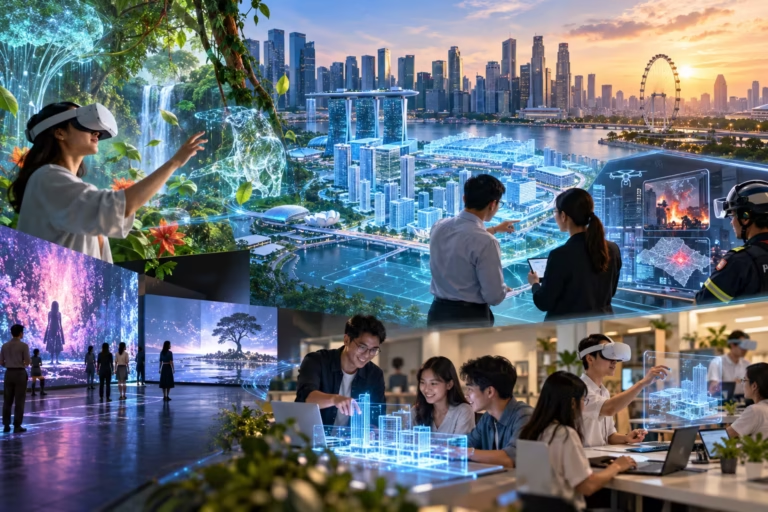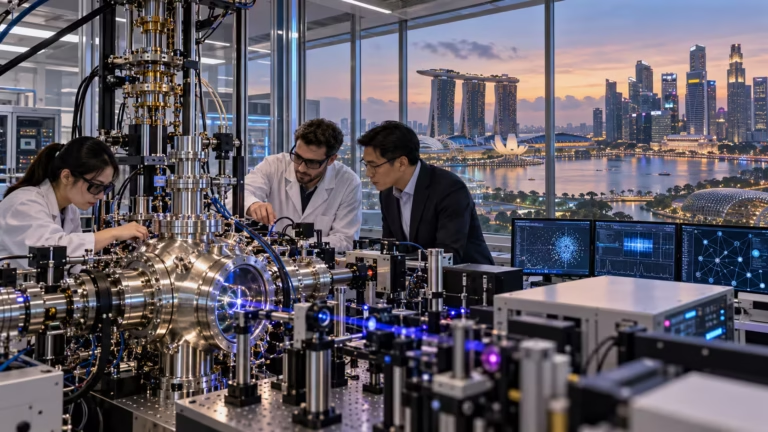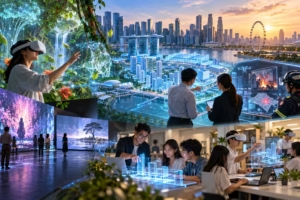

Singapore’s climate constraints make it a demanding test environment for new technology. The city-state has limited land, high energy demand, dependence on imported food, dense infrastructure, and exposure to rising temperatures and extreme rainfall.
These pressures are encouraging startups to develop science-based solutions in energy storage, sustainable food, water management, carbon reduction, and advanced materials.
Climate Technology Beyond Consumer Products
Many sustainability businesses focus on marketplaces, carbon-tracking applications, or environmentally friendly consumer goods. Climate deep tech operates at a different level.
These companies may develop new battery chemistries, biological production systems, industrial materials, carbon-capture processes, or technologies that require pilot plants and engineering validation.
Their commercial development is difficult because customers are often utilities, manufacturers, property developers, governments, or food producers. Sales cycles can be long, and deployment may require changes to existing infrastructure.
The Singapore Economic Development Board provides official information about the country’s industrial and innovation environment: Singapore Economic Development Board.
Energy Storage as a Regional Opportunity
Renewable energy is expanding across Asia, but solar and wind generation fluctuate. Energy-storage systems are therefore essential for balancing supply and demand.
Singapore-based VFlowTech has developed vanadium redox flow battery technology. Flow batteries are designed for stationary storage applications and may offer advantages for long-duration use because energy is stored in liquid electrolytes.
From Laboratory Performance to Industrial Reliability
Battery startups must prove more than energy capacity. Customers evaluate safety, operating life, maintenance needs, efficiency, cost, and performance under tropical conditions.
A system that performs well in a controlled laboratory must also survive heat, humidity, heavy use, and long operating cycles. Pilot projects are essential because they generate performance data that can support larger commercial contracts.
Singapore can provide credible test sites, but regional expansion is necessary to reach markets with larger renewable-energy projects.
Food Security Creates a Natural Test Market
Singapore imports most of its food, making food security a strategic concern. This has encouraged interest in alternative proteins, fermentation technologies, controlled-environment agriculture, and cultivated seafood.
Companies such as Shiok Meats emerged from Singapore’s effort to develop cell-based seafood. The broader sector has attracted attention because cultivated products may reduce pressure on marine resources and strengthen supply resilience.
However, commercial viability remains challenging. Production costs must fall substantially, bioreactors must operate efficiently, and products must meet consumer expectations for taste, texture, safety, and price.
Regulatory approval is only one milestone. Long-term success depends on repeat purchases and scalable manufacturing.
Urban Infrastructure as a Deep-Tech Laboratory
Singapore’s dense urban environment also creates opportunities for cooling technologies, water recycling, smart-building systems, and flood-resilience solutions.
Advanced materials could help reduce heat absorption in buildings. Sensors and predictive systems could identify water leaks or infrastructure risks. New cooling approaches could lower energy use in data centers and commercial properties.
The city’s compact size allows technologies to be tested in closely monitored environments. Government agencies, universities, property developers, and infrastructure operators can collaborate on pilots and share technical feedback.
The Financing Gap for Climate Hardware
Climate deep-tech companies often need more capital than software startups. A pilot plant or manufacturing line can cost millions before meaningful revenue is generated.
Traditional venture capital may be reluctant to support long development cycles and infrastructure risk. These startups may need blended financing involving government grants, strategic corporate investors, project finance, and specialist climate funds.
Singapore’s strongest role may be as a research, financing, and demonstration center rather than the location for every stage of large-scale production. Startups that design in Singapore and deploy across Southeast Asia could address much larger energy, food, and infrastructure markets.